
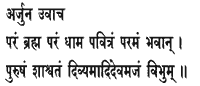
Arjuna said: Thou art the supreme Brahman, the supreme Abode, the supreme Purity, the one permanent, the divine Purusha, the original Godhead, the Unborn, the all-pervading Lord.
The Divine Worker
Sri Aurobindo
TO ATTAIN to the divine birth,—a divinising new birth of the soul into a higher consciousness,—and to do divine works both as a means towards that before it is attained and as an expression of it after it is attained, is then all the Karmayoga of the Gita. The Gita does not try to define works by any outward signs through which it can be recognisable to an external gaze, measurable by the criticism of the world; it deliberately renounces even the ordinary ethical distinctions by which men seek to guide themselves in the light of the human reason. The signs by which it distinguishes divine works are all profoundly intimate and subjective; the stamp by which they are known is invisible, spiritual, supra-ethical. They are recognisable only by the light of the soul from which they come. For, it says, “what is action and what is inaction, as to this even the sages are perplexed and deluded,” because, judging by practical, social, ethical, intellectual standards, they discriminate by accidentals and do not go to the root of thematter; “I will declare to thee that action by the knowledge of which thou shalt be released from all ills. One has to understand about action as well as to understand about wrong action and about inaction one has to understand; thick and tangled is the way of works.” Action in the world is like a deep forest, gahana, through which man goes stumbling as best he can, by the light of the ideas of his time, the standards of his personality, his environment, or rather of many times, many personalities, layers of thought and ethics from many social stages all inextricably confused together, temporal and conventional amidst all their claim to absoluteness and immutable truth, empirical and irrational in spite of their aping of right reason. And finally the sage seeking in the midst of it all a highest foundation of fixed law and an original truth finds himself obliged to raise the last supreme question, whether all action and life itself are not a delusion and a snare and whether cessation from action, akarma, is not the last resort of the tired and disillusioned human soul. But, says Krishna, in this matter even the sages are perplexed and deluded. For by action, by works, not by inaction comes the knowledge and the release. What then is the solution? what is that type of works by which we shall be released from the ills of life, from this doubt, this error, this grief, from this mixed, impure and baffling result even of our purest and best-intentioned acts, from these million forms of evil and suffering? No outward distinctions need be made, is the reply; no work the world needs, be shunned; no limit or hedge set round our human activities; on the contrary, all actions should be done, but from a soul in Yoga with the Divine, yuktah. kr.tsna-karma-kr.t. Akarma, cessation from action is not the way; the man who has attained to the insight of the highest reason, perceives that such inaction is itself a constant action, a state subject to the workings of Nature and her qualities. The mind that takes refuge in physical inactivity, is still under the delusion that it and not Nature is the doer of works; it has mistaken inertia for liberation; it does not see that even in what seems absolute inertia greater than that of the stone or clod, Nature is at work, keeps unimpaired her hold. On the contrary in the full flood of action the soul is free from its works, is not the doer, not bound by what is done, and he who lives in the freedom of the soul, not in the bondage of the modes of Nature, alone has release from works. This is what the Gita clearlymeans when it says that he who in action can see inaction and can see action still continuing in cessation from works, is the man of true reason and discernment among men. This saying hinges upon the Sankhya distinction between Purusha and Prakriti, between the free inactive soul, eternally calm, pure and unmoved in the midst of works, and ever active Nature operative as much in inertia and cessation as in the overt turmoil of her visible hurry of labour. This is the knowledge which the highest effort of the discriminating reason, the buddhi, gives to us, and therefore whoever possesses it is the truly rational and discerning man, sa buddhim¯an manus.yes.u,—not the perplexed thinker who judges life and works by the external, uncertain and impermanent distinctions of the lower reason. Therefore the liberated man is not afraid of action, he is a large and universal doer of all works, kr.tsna-karma-kr.t; not as others do them in subjection toNature, but poised in the silent calm of the soul, tranquilly in Yoga with the Divine. The Divine is the lord of his works, he is only their channel through the instrumentality of his nature conscious of and subject to her Lord. By the flaming intensity and purity of this knowledge all his works are burned up as in a fire and his mind remains without any stain or disfiguring mark from them, calm, silent, unperturbed, white and clean and pure. To do all in this liberating knowledge, without the personal egoism of the doer, is the first sign of the divine worker. The second sign is freedom from desire; for where there is not the personal egoism of the doer, desire becomes impossible; it is starved out, sinks for want of a support, dies of inanition. Outwardly the liberated man seems to undertake works of all kinds like other men, on a larger scale perhaps with a more powerful will and driving-force, for the might of the divine will works in his active nature; but from all his inceptions and undertakings the inferior concept and nether will of desire is entirely banished, sarve sama¯rambha¯h. ka¯masan˙ kalpavarjita¯h.. He has abandoned all attachment to the fruits of his works, and where one does not work for the fruit, but solely as an impersonal instrument of the Master of works, desire can find no place,— not even the desire to serve successfully, for the fruit is the Lord’s and determined by him and not by the personal will and effort, or to serve with credit and to the Master’s satisfaction, for the real doer is the Lord himself and all glory belongs to a form of his Shakti missioned in the nature and not to the limited human personality. The human mind and soul of the liberated man does nothing, na kin˜ cit karoti; even though through his nature he engages in action, it is the Nature, the executive Shakti, it is the conscious Goddess governed by the divine Inhabitant who does the work. It does not follow that the work is not to be done perfectly, with success, with a right adaptation of means to ends: on the contrary a perfect working is easier to action done tranquilly in Yoga than to action done in the blindness of hopes and fears, lamed by the judgments of the stumbling reason, running about amidst the eager trepidations of the hasty human will: Yoga, says the Gita elsewhere, is the true skill in works, yogah. karmasu kau´salam. But all this is done impersonally by the action of a great universal light and power operating through the individual nature. The Karmayogin knows that the power given to him will be adapted to the fruit decreed, the divine thought behind the work equated with the work he has to do, the will in him,— which will not be wish or desire, but an impersonal drive of conscious power directed towards an aim not his own,—subtly regulated in its energy and direction by the divine wisdom. The result may be success, as the ordinary mind understands it, or it may seem to that mind to be defeat and failure; but to him it is always the success intended, not by him, but by the all-wise manipulator of action and result, because he does not seek for victory, but only for the fulfilment of the divine will and wisdom which works out its ends through apparent failure as well as and often with greater force than through apparent triumph. Arjuna, bidden to fight, is assured of victory; but even if certain defeat were before him, he must still fight because that is the present work assigned to him as his immediate share in the great sum of energies by which the divine will is surely accomplished. The liberated man has no personal hopes; he does not seize on things as his personal possessions; he receives what the divine Will brings him, covets nothing, is jealous of none: what comes to him he takes without repulsion and without attachment; what goes from him he allows to depart into the whirl of things without repining or grief or sense of loss. His heart and self are under perfect control; they are free from reaction and passion, they make no turbulent response to the touches of outward things. His action is indeed a purely physical action, s´a¯rı¯ram˙ kevalam˙ karma; for all else comes from above, is not generated on the human plane, is only a reflection of the will, knowledge, joy of the divine Purushottama. Therefore he does not by a stress on doing and its objects bring about in his mind and heart any of those reactions which we call passion and sin. For sin consists not at all in the outward deed, but in an impure reaction of the personal will, mind and heart which accompanies it or causes it; the impersonal, the spiritual is always pure, ap¯apaviddham, and gives to all that it does its own inalienable purity. This spiritual impersonality is a third sign of the divine worker. All human souls, indeed, who have attained to a certain greatness and largeness are conscious of an impersonal Force or Love or Will and Knowledge working through them, but they are not free from egoistic reactions, sometimes violent enough, of their human personality. But this freedom the liberated soul has attained; for he has cast his personality into the impersonal, where it is no longer his, but is taken up by the divine Person, the Purushottama, who uses all finite qualities infinitely and freely and is bound by none. He has become a soul and ceased to be a sum of natural qualities; and such appearance of personality as remains for the operations of Nature, is something unbound, large, flexible, universal; it is a free mould for the Infinite, it is a living mask of the Purushottama. The result of this knowledge, this desirelessness and this impersonality is a perfect equality in the soul and the nature. Equality is the fourth sign of the divine worker. He has, says the Gita, passed beyond the dualities; he is dvandv¯ at¯ıta. We have seen that he regards with equal eyes, without any disturbance of feeling, failure and success, victory and defeat; but not only these, all dualities are in him surpassed and reconciled. The outward distinctions by which men determine their psychological attitude towards the happenings of the world, have for him only a subordinate and instrumental meaning. He does not ignore them, but he is above them. Good happening and evil happening, so all-important to the human soul subject to desire, are to the desireless divine soul equally welcome since by their mingled strand are worked out the developing forms of the eternal good. He cannot be defeated, since all for him is moving towards the divine victory in the Kurukshetra ofNature, dharmaks.etre kuruks.etre, the field of doings which is the field of the evolving Dharma, and every turn of the conflict has been designed and mapped by the foreseeing eye of the Master of the battle, the Lord of works and Guide of the dharma. Honour and dishonour from men cannot move him, nor their praise nor their blame; for he has a greater clear-seeing judge and another standard for his action, and his motive admits no dependence upon worldly rewards. Arjuna the Kshatriya prizes naturally honour and reputation and is right in shunning disgrace and the name of coward as worse than death; for to maintain the point of honour and the standard of courage in the world is part of his dharma: but Arjuna the liberated soul need care for none of these things, he has only to know the kartavyam˙ karma, the work which the supreme Self demands from him, and to do that and leave the result to the Lord of his actions. He has passed even beyond that distinction of sin and virtue which is so allimportant to the human soul while it is struggling to minimise the hold of its egoism and lighten the heavy and violent yoke of its passions,—the liberated has risen above these struggles and is seated firmly in the purity of the witnessing and enlightened soul. Sin has fallen away from him, and not a virtue acquired and increased by good action and impaired or lost by evil action, but the inalienable and unalterable purity of a divine and selfless nature is the peak to which he has climbed and the seat upon which he is founded. There the sense of sin and the sense of virtue have no starting-point or applicability. Arjuna, still in the ignorance, may feel in his heart the call of right and justice and may argue in his mind that abstention from battle would be a sin entailing responsibility for all the suffering that injustice and oppression and the evil karma of the triumph of wrong bring upon men and nations, or hemay feel in his heart the recoil from violence and slaughter and argue in his mind that all shedding of blood is a sin which nothing can justify. Both of these attitudes would appeal with equal right to virtue and reason and it would depend upon the man, the circumstances and the time which of these might prevail in his mind or before the eyes of the world. Or he might simply feel constrained by his heart and his honour to support his friends against his enemies, the cause of the good and just against the cause of the evil and oppressive. The liberated soul looks beyond these conflicting standards; he sees simply what the supreme Self demands from him as needful for the maintenance or for the bringing forward of the evolving Dharma. He has no personal ends to serve, no personal loves and hatreds to satisfy, no rigidly fixed standard of action which opposes its rock-line to the flexible advancing march of the progress of the human race or stands up defiant against the call of the Infinite. He has no personal enemies to be conquered or slain, but sees only men who have been brought up against him by circumstances and the will in things to help by their opposition the march of destiny. Against them he can have no wrath or hatred; for wrath and hatred are foreign to the divine nature. The Asura’s desire to break and slay what opposes him, the Rakshasa’s grim lust of slaughter are impossible to his calm and peace and his all-embracing sympathy and understanding. He has no wish to injure, but on the contrary a universal friendliness and compassion, maitrah. karun.a eva ca: but this compassion is that of a divine soul overlooking men, embracing all other souls in himself, not the shrinking of the heart and the nerves and the flesh which is the ordinary human form of pity: nor does he attach a supreme importance to the life of the body, but looks beyond to the life of the soul and attaches to the other only an instrumental value. He will not hasten to slaughter and strife, but if war comes in the wave of the Dharma, he will accept it with a large equality and a perfect understanding and sympathy for those whose power and pleasure of domination he has to break and whose joy of triumphant life he has to destroy. For in all he sees two things, the Divine inhabiting every being equally, the varying manifestation unequal only in its temporary circumstances. In the animal and man, in the dog, the unclean outcaste and the learned and virtuous Brahmin, in the saint and the sinner, in the indifferent and the friendly and the hostile, in those who love him and benefit and those who hate him and afflict, he sees himself, he sees God and has at heart for all the same equal kindliness, the same divine affection. Circumstances may determine the outward clasp or the outward conflict, but can never affect his equal eye, his open heart, his inner embrace of all. And in all his actions there will be the same principle of soul, a perfect equality, and the same principle of work, the will of the Divine in him active for the need of the race in its gradually developing advance towards the Godhead. Again, the sign of the divine worker is that which is central to the divine consciousness itself, a perfect inner joy and peace which depends upon nothing in the world for its source or its continuance; it is innate, it is the very stuff of the soul’s consciousness, it is the very nature of divine being. The ordinary man depends upon outward things for his happiness; therefore he has desire; therefore he has anger and passion, pleasure and pain, joy and grief; therefore he measures all things in the balance of good fortune and evil fortune. None of these things can affect the divine soul; it is ever satisfied without any kind of dependence, nitya-tr.pto nir ¯a´srayah. ; for its delight, its divine ease, its happiness, its glad light are eternal within, ingrained in itself, ¯atma-ratih. , antah. -sukho ’ntar- ¯ ar ¯amas tath ¯antar-jyotir eva yah. .What joy it takes in outward things is not for their sake, not for things which it seeks in them and can miss, but for the self in them, for their expression of the Divine, for that which is eternal in them and which it cannot miss. It is without attachment to their outward touches, but finds everywhere the same joy that it finds in itself, because its self is theirs, has become one self with the self of all beings, because it is united with the one and equal Brahman in them through all their differences, brahmayogayukta ¯tma¯ , sarvabhu¯ ta¯tma-bhu¯ ta¯tma¯ . It does not rejoice in the touches of the pleasant or feel anguish in the touches of the unpleasant; neither the wounds of things, nor the wounds of friends, nor the wounds of enemies can disturb the firmness of its outgazing mind or bewilder its receiving heart; this soul is in its nature, as the Upanishad puts it, avran.am, without wound or scar. In all things it has the same imperishable Ananda, sukham aks.ayam a´snute. That equality, impersonality, peace, joy, freedom do not depend on so outward a thing as doing or not doing works. The Gita insists repeatedly on the difference between the inward and the outward renunciation, ty ¯aga and sanny¯asa. The latter, it says, is valueless without the former, hardly possible even to attain without it, and unnecessary when there is the inward freedom. In fact ty ¯aga itself is the real and sufficient Sannyasa. “He should be known as the eternal Sannyasin who neither hates nor desires; free from the dualities he is happily and easily released from all bondage.” The painful process of outward Sannyasa, duh.kham ¯aptum, is an unnecessary process. It is perfectly true that all actions, as well as the fruit of action, have to be given up, to be renounced, but inwardly, not outwardly, not into the inertia of Nature, but to the Lord in sacrifice, into the calm and joy of the Impersonal from whom all action proceeds without disturbing his peace. The true Sannyasa of action is the reposing of all works on the Brahman. “He who, having abandoned attachment, acts reposing (or founding) his works on the Brahman, brahman. y¯adh¯aya karm¯an. i, is not stained by sin even as water clings not to the lotus-leaf.” Therefore the Yogins first “do works with the body, mind, understanding, or even merely with the organs of action, abandoning attachment, for self-purification, san˙ gam˙ tyaktva¯tmas´uddhaye. By abandoning attachment to the fruits of works the soul in union with Brahman attains to peace of rapt foundation in Brahman, but the soul not in union is attached to the fruit and bound by the action of desire.” The foundation, the purity, the peace once attained, the embodied soul perfectly controlling its nature, having renounced all its actions by the mind, inwardly, not outwardly, “sits in its ninegated city neither doing nor causing to be done.” For this soul is the one impersonal Soul in all, the all-pervading Lord, prabhu, vibhu, who, as the impersonal, neither creates the works of the world, nor the mind’s idea of being the doer, na kartr.tvam˙ na karm¯an. i, nor the coupling of works to their fruits, the chain of cause and effect. All that is worked out by theNature in theman, svabh¯ava, his principle of self-becoming, as the word literally means. The all-pervading Impersonal accepts neither the sin nor the virtue of any: these are things created by the ignorance in the creature, by his egoism of the doer, by his ignorance of his highest self, by his involution in the operations of Nature, and when the self-knowledge within him is released from this dark envelope, that knowledge lights up like a sun the real self within him; he knows himself then to be the soul supreme above the instruments of Nature. Pure, infinite, inviolable, immutable, he is no longer affected; no longer does he imagine himself to be modified by her workings. By complete identification with the Impersonal he can, too, release himself from the necessity of returning by birth into her movement. And yet this liberation does not at all prevent him from acting. Only, he knows that it is not he who is active, but the modes, the qualities of Nature, her triple gun. as. “The man who knows the principles of things thinks, his mind in Yoga (with the inactive Impersonal), ‘I am doing nothing’; when he sees, hears, touches, smells, eats, moves, sleeps, breathes, speaks, takes, ejects, opens his eyes or closes them, he holds that it is only the senses acting upon the objects of the senses.” He himself, safe in the immutable, unmodified soul, is beyond the grip of the three gunas, trigun. ¯ at¯ıta; he is neither sattwic, rajasic nor tamasic; he sees with a clear untroubled spirit the alternations of the natural modes and qualities in his action, their rhythmic play of light and happiness, activity and force, rest and inertia. This superiority of the calm soul observing its action but not involved in it, this traigun. ¯ at¯ıtya, is also a high sign of the divine worker. By itself the idea might lead to a doctrine of the mechanical determinism of Nature and the perfect aloofness and irresponsibility of the soul; but the Gita effectively avoids this fault of an insufficient thought by its illumining supertheistic idea of the Purushottama. It makes it clear that it is not in the end Nature which mechanically determines its own action; it is the will of the Supreme which inspires her; he who has already slain the Dhritarashtrians, he of whom Arjuna is only the human instrument, a universal Soul, a transcendent Godhead is the master of her labour. The reposing of works in the Impersonal is a means of getting rid of the personal egoism of the doer, but the end is to give up all our actions to that great Lord of all, sarva-loka-mahe´svara. “With a consciousness identified with the Self, renouncing all thy actions into Me, mayi sarv ¯an.i karm¯an. i sannyasy¯adhy¯atmacetas¯a, freed from personal hopes and desires, from the thought of ‘I’ and ‘mine’, delivered from the fever of the soul, fight,” work, do my will in the world. The Divine motives, inspires, determines the entire action; the human soul impersonal in the Brahman is the pure and silent channel of his power; that power in the Nature executes the divine movement. Such only are the works of the liberated soul, muktasya karma, for in nothing does he act from a personal inception; such are the actions of the accomplished Karmayogin. They rise from a free spirit and disappear without modifying it, like waves that rise and disappear on the surface of conscious, immutable depths. Gata-san˙ gasya muktasya jn˜ a¯na¯vasthita-cetasah. , yajn˜ a¯ya¯caratah. karma samagram˙ pravilı¯yate.
Sri Aurobindo
 About Us | ©1999 - 2009 searchforlight.org
All extracts and quotations from the written works of Sri Aurobindo and the Mother and the Photographs of
the Mother and Sri Aurobindo are copyright Sri Aurobindo Ashram Trust, Pondicherry -605002 India.